Democracy – Older than Parliaments
By Gwydion M. Williams
- Bernie Sanders as Liberal Imperialist
- US and Britain had Undemocratic Parliamentarianism
- Parliaments for the Privileged
- Dollar Crusaders
- Western Failures
- Versions of Partial Democracy
- Vocational Democracy?
- Alternative Democracy
Western parliamentary democracy grew out of electoral systems that gave political rights just to white males who were rich enough to count as upper middle class. The systems remained mostly peaceful because change was gradual. It is not a system you can sensibly expect to stand when it is set up with no social foundations in a non-Western society. Ukraine is a notable failure
Bernie Sanders as Liberal Imperialist
Bernie Sanders and similar Left Democrats are much like what the Labour Party in Britain before Blair converted it to Thatcherism. The rest of the US Democrats are now like Britain’s Tories. US Republicans are off the scale in West European terms.
But in their current conflict, truth and justice are decidedly mixed. Trump’s people are wrong about the economy, but correct in seeking peace for Ukraine. I’m sure their motives are selfish: just as keen as Democrats to make Ukraine another backyard for US culture and US economics, but aware that it isn’t working.
Saunders is on the wrong side when it comes to the Ukraine War. He says
“For 250 years, the United States has supported democracy.
“Now, in the middle of a horrific war that Putin started, Trump is turning his back on Ukraine and democracy, all to the benefit of a brutal dictator in Moscow.”[1]
I’ve explained elsewhere why Kiev’s war began in 2014, when pro-Western politicians broke the rules of regular democracy.[2] They let a Far Right mob drive out the President who had been democratically elected in 2010, reversing their earlier First Orange Revolution. They did not take him up on an offer of a new Presidential election held ahead of schedule. And because of that, the unity of this newly-self-governing state was shattered.
The key issue now is Democratic Secession – do the majority in a region have a right to leave a sovereign state?
The Bolsheviks created Soviet Ukraine out of two Tsarist Provinces. ‘Little Russia’ was a Tsarist name for people variously known as Ukrainians or Cossacks: and insultingly as Little Russians. People seen as inferior to the Great Russians centered around Moscow. South Russia had earlier been New Russia – territory that Russians and Ukrainians were able to settle after Moscow’s armies conquered Crimea, a slave-raiding base for the Ottoman Empire. People freely moved there within the Tsarist Empire, and later within the Soviet Union.

Crimea, much more strongly dominated by Russians after Crimean Tartars were expelled following their collaboration with the Nazis in World War Two, had been part of the Russian Federation till the 1950s. Khrushchev, who was born in Soviet Russia but grew up in Soviet Ukraine, chose to move them.
Yeltsin, having been elected as a President of Russia with limited powers, pushed aside Gorbachev after a failed coup by traditionalists. He then got together with the leaders of Ukraine and Belarus to secede from the Soviet Union – a right that Lenin had included when he consolidated Bolshevik power. This left Gorbachev stranded, and avoided the risk of Yeltsin not being chosen if he had needed to seek a new mandate for a vastly more powerful position.
It was assumed that the new independent states would be friendly and successful. But things actually went so badly that the refounded Russian Communists almost got re-elected in 1997. The economy shrank. A botched privatisation delivered vast wealth to undeserving and corrupt oligarchs. This happened in both Russia and Ukraine. In Belarus, the leader from Soviet times hung on and avoided the disasters. And in Russia, Putin turned things round and is a very popular authoritarian who keeps winning open elections. But Ukraine remained a mess, constantly rejecting whichever President it had elected last time.


A refounded Ukrainian Communist Party remained quite popular in the south and east. And many more saw the Soviet era as having had merits, whereas in West Ukraine a majority saw only the negatives.

Something similar happened in Czechoslovakia. There was no right of secession, but when an election produced a deadlock between a centre-right Czech party and a centre-left Slovak party, a majority in each agreed to a peaceful separation.
In Yugoslavia, there was also a right of secession. Croatia was dominated by a centre-right party that whitewashed the pro-Nazi Croat government, including their mass killing of Jews and Serb regions. Serbia kept more centre-left. There, the secession of Croatia took with it majority-Serb regions, which resisted for a time but were conquered by a NATO-trained army. Bosnia fragmented and remains split. And the West waged war to give independence to majority-Albanian Kosovo, including even the majority-Serb north. Russia correctly saw this as a destruction of the rule-based order that the West had promised.
Ukraine might have sensibly split east and west, but the lines were unclear. A ding-dong struggle reversed the First Orange Revolution in 2010. In 2014, a Second Orange Revolution refused an offer of a new Presidential election ahead of schedule. They used mob violence to chase him out. Parliament declared him deposed, ignoring their own constitution that elaborate rules for impeachment based on the US system. Russia reacted by helping the elected regional government of Crimea when it seceded, granting its wish to be part of Russia. The two elected regional government of the Donbass meantime asked for autonomy. Violence began when right-wing militias were given weapons by the regular army. When they began shelling Donbass City, which at the time Western media reported freely.
Sanders ignores this issue, as do most of Kiev’s fans. And incidentally, I will go on using the name Kiev and other long-accepted forms until that government stops seeking the ethnic cleansing of the minority who were content with the pre-2014 balance. Until they stop trying to ethnically cleanse those who wanted to hang onto the version of Ukraine that was set up by Russia-loving politicians in 1991. It was the Orange faction that broke the norm and declared that bitter hostility to everything Russian or Soviet should be the new norm.
Note also that the UN has never said whether or not Democratic Secession is a right. The Charter speaks both of territorial integrity and a right of self-determination. Anti-colonialists added and got accepted the notion of non-self-governing territories: that was used to justify dismantling European empires. And things were clear enough between Europe and its overseas possessions: none of the European governments were willing to give their non-white subjects any real power.[3] But the newly sovereign ex-colonies had a lot of diversity within themselves. Mostly the existing leaders wanted to keep everything they had inherited, even in some cases dismantling federal arrangements and promises of autonomy. The former colonial powers mostly supported them. And usually but not always, the USA and the Soviet Union as rival superpowers preferred to keep a friend or potential friend rather than establish a system of real justice.
I’m also sure that a right of democratic secession is not feasible in the current world. Nor any world that we might feasibly see for decades to come. Perhaps never. Had the UN become a real World Government it would have been different, but that was never likely.
Given the fact that International Law has only ever been based on power, I take the view that democratic secession will never be respected unless someone threatens or fights a war to enforce it. Anyone thinking of it should be warned, and advised that they are likely to pay a terrible price and also likely to fail eventually.
Sometimes a state can be persuaded to let a regional majority go free. Or split, as did the Czech and Slovak Republics. Regions can even be thrown out, as Singapore was expelled from Malaysia in 1965. But when the sovereign power will not agree, it is done by force or else becomes a dead issue.
People seeking their own idea of justice must realise that UN votes on such matters are never about law, democracy, or justice. If the outcome seems just to me or to you or to both of us, it would remain a fact that this is only because the accidents of power politics happen to be favourable.
The Republic of India denies self-determination to the Muslim majority parts of Kashmir, but enforced it with a war for Bangladesh. The Turkish Republic secured it for the Turkish Cypriots, though the UN will not recognise Northern Cyprus as a state. Likewise South Ossetia – an unrecognised claimant to be a sovereign state, accepted only by Russia and a few global friends.
Had Kiev managed to suppress and repress the Donbass and the other regions given self-determination by Russian armies, I would say that it was one of many injustices that were best lived with. And it is definitely possible that had Kiev been more reasonable, some of the territories now taken into Russia would have chosen to stay as an inferior backyard to the West. But none of it can be called a matter of democracy.
US and Britain had Undemocratic Parliamentarianism
Why does Sanders get it wrong? I think his knowledge of history is weak, and filled with standard US illusions. Let’s look back at his opening paragraph:
“For 250 years, the United States has supported democracy.”[4]
He has been correctly told off for not mentioning that this ‘democracy’ kept slavery for longer than almost all of the rest of the Western world.[5] And was much the same as other Western societies in extending the vote to women: isolated and limited cases in the 19th century, and in a great wave from 1917 to 1919.[6] And with the UK excluding women under 30 until 1928, and France excluding all women until 1945, incidentally. But it gets overlooked how all parliamentary systems were created just for the richer men, sometimes also limited by religion or birthplace or occasionally race. It gets overlooked how parliaments were something quite different from democracy, which mostly did not operate above the level of tribes that gave equal rights to all members of the tribe.
The USA didn’t definitely establish voting for all white males till the early 19th century. Done piecemeal, with Andrew Jackson’s election as President in 1828 a convenient place to draw a line between pre-democracy and white-male democracy. Jackson was a slave owner, like four of the six Presidents before him. The exceptions were John Adams and John Quincy Adams, who were also the only father-son pair to hold the office before George H. W. Bush and George W. Bush.

It was also Jackson’s first vice-president, John C. Calhoun, who pioneered the idea that slavery was something good in itself, rather than an unfortunate survival of what the British Empire had allowed. And yet Calhoun was by every other criterion a pioneer of liberal values. Nothing exceptional in the history of liberalism: John Locke wrote against slavery but was indirectly involved in it. And both James Mill and his more famous son John Stuart Mill supported British rule over the Indian subcontinent. James argued in detail that the native population were unfit to rule themselves, and his son the famous liberal philosopher supported this.[7] Both worked in the London offices of the East India Company, and never visited India.
Meantime in the USA, most Northern states that had banned slavery before the Civil War also denied legal and voting rights to Afro-Americans.[8]
What was established in British North America in the 1770s was independent government for the various elites. Then in the 1780s they agreed to pool many government functions, notably half-settled lands they were taking from Native Americans and rival Europeans. Part of the price for the new Constitution was including Fugitive Slave rules in their new Constitution. (Article IV, Section 2, Clause 3.)
Having dealt with these specifics, I will now examine the broader history of the interactions between parliaments and democracy.
Parliaments for the Privileged
British democracy was achieved by the gradual reform of a system that was originally meant to give a limited voice to men of the upper-middle classes.
It is not a model that we should hold up as an ideal for the rest of the world.
Nor fight wars in the hope of spreading it to places that already had a coherent government.
Many countries including China and the former Soviet Union have Alternative Democracies. Systems that suit the wishes of most of their inhabitants. Many gave up on parliamentary systems when they kept failing to deliver what the winning party promised. Or when autocratic government seemed the only way to end or avoid civil war.
The West’s relatively peaceful societies with parliamentary governments were anyway achieved by some pretty unpleasant methods. Generally peace came first, achieved by mass repressions. Roman Catholics in Ireland were a majority and were massively repressed. In the rest of Britain they were a politically inert minority and were merely excluded from some aspects of citizenship. As were ‘Nonconformists’: Protestants not willing to show at least nominal acceptance of the Church of England, though they were not excluded to the same degree. And for Scotland, where a majority and many of the elite were Presbyterians, this became the official church, with the monarch officially head of two churches with incompatible theologies.
It was on this basis that British parliaments then functioned. They operated on an understanding that no one should go too far against the new consensus. And in the longer run religious rules were relaxed, even allowing non-Christians – mostly Jews – to become MPs.
Tolerance is generally a reward for most of the population accepting and internalising ideas that were originally imposed on them. It is assumed that anyone disagreeing can be safely left in their own minority existence. When Western politicians call their rivals a threat to democracy, they do not act or function as if they believed it. Trump strained it, for the first time since their 1860s civil war. But Biden handed over power as if all were normal. And as of now, March 8th 2025, it remains a strained version of normal politics.[9]
They are also loyal to a system that was not made by democratic methods. The USA inherited British traditions of elected governments, but I explained earlier that it was not even a vote for all white men for the first half-century. And there was and still is a habit of letting the existing ruling class rule. A ruling class that can now include people born middling or poor, if their minds have been suitably adjusted as they rose within the existing social order.
Things were different in the early 19th century. Andrew Jackson taking office in 1829 was the first President from outside the narrow elite that had ruled for Britain before declaring independence. The creation of the USA had been much more a secession by existing regional governments than a real revolution.
For England, all five monarchs of the Tudor dynasty extended royal power far beyond previous bounds: it is unfair that only Henry 8th gets routinely listed as a tyrant. And a further major stage was the dictatorial rule of Oliver Cromwell, descendant of a sister of Henry’s minister Thomas Cromwell.
If you believe that making the modern democratic world was all nice apart from some needless errors, you are not thinking in realistic terms. Not terms that would guide you successfully to spreading your own values. And indeed, the ‘Dollar Crusaders’ who had this mission after the Soviet collapse have screwed up. Been absurdly unsuccessful in remoulding the world according to their wishes, given the dominance they had in the 1990s.
There’s an old joke about there being one reliable way to go gambling in Las Vegas and return with a small fortune. You go there with a large fortune.
It neatly fits the thirty-plus years of the Dollar Crusaders. Placed in a unique position of strength, they were immoral and brutal without being very effective. They threw it all away. Britain got Brexit, and the USA has opted for a second dose of Trump.
Sheer arrogant incompetence lost them the friendship of Russia, very keen to learn and be an ally in 1991. Trump is in some ways being smarter, seeking to get back to something more like the friendly relations that the Dollar Crusaders wasted.
The blunders of the 1990s also repelled China. China’s armed forces currently number three millions, including reserves and paramilitaries. And that’s after being gradually downsized from much larger numbers under Mao. Had Russia been treated as Poland was – helped to new prosperity rather than looted and told it was their fault – a different Chinese leadership might have emerged. One willing to be part of a US hegemony, and they could easily have raised millions more military. Currently they turn away high-quality volunteers, whereas the USA has to bribe much of its military with loans and scholarships, or just the prospect of staying out of jail. China currently is 134th out of 175 in terms of military per total population: a very modest 2.1 per thousand.[10] The United States has 6.3, and Norway 11.8.
They harmed Russia, and thought that China must see a collapse of Leninism and a submission to US values. And before the panic of the last few years, they sneered at wounded Russia as ‘Upper Volta with nukes’. Not thinking that if weapons of mass destruction were actually possessed by Upper Volta – now Burkina Faso – they would have a lot more ‘clout’ in an unjust world order.
It was supposed that a bunch of allies and mercenaries would do the job. They were even surprised when a bunch of corrupt warlords and assorted drug barons bolted in Afghanistan as soon as Western forces pulled out. Those left behind were sincere liberals who had mostly expected someone else to do the fighting and the dying. They were left helpless, with the Taliban much stronger and more secure than before the US invasion. Most have been dumped by their Western ‘friends’, with governments out to limit costs and placate homegrown racists.
US liberals are no different from Trump in always finding someone else at fault when they messed up. Having lost Russia as a friend, they then spread the tale that Putin was a mad dictator who would soon be rejected by the poor oppressed Russians. That he was reviving the attempt to dominate Europe that all Russians had actually abandoned in 1989, when it was made clear that unpopular regimes in Middle Europe could not expect Russian tanks to save them. And sadly, this absurd story convinced a democratic majority in the West. But was not taken seriously by even 5% of Russians – pro-Western parties have fallen below this threshold since 2003.[11] Plenty of Russian MPs oppose Putin on other matters, but not one was against his Ukraine war.
The New Right and its docile followers in New Labour and the Clinton Democrats tried to make history, but with fixed and false ideas about how history had previously been made.
The mediaeval English parliament was never made to be democratic, or to rule. It was based on a Continental European model, intended to give the relatively privileged a voice that must be respected by the actual royal government. England had a House of Commons with unpaid members, and they were usually knights or ‘burgesses’; privileged town dwellers. Scotland had a similar system. And in Ireland from the 17th century, Roman Catholics could not be elected to their separate parliament.
When the unified United Kingdom parliament was reformed in 1832, the choice was to give votes just to the richest one seventh of adult men living in the British Isles. Similar systems also existed in other parts of the British Empire, but never giving significant power to those not judged part of an officially-recognised White Race. This was also a criterion for military officers by land and sea, with very few exceptions.
Race was never a major issue for people living within the British Isles, and even voting there. Any subject of the empire was free to move here, but this included only a few of those not recognised as part of the White Race, and some of the non-whites were rich. But for the rest of the British Empire, even the elite among the ‘natives’ were essentially powerless. And it was this that meant that the Empire had a relatively short lifetime, as empires go. I’d count less than 19 decades, from the ‘Wonderful Year’ of 1759 to the humiliation of losing Singapore to a smaller Japanese army in 1942.
Imperial Britons postured as a new Roman Empire, but White Racism stopped them from learning the lessons that kept Rome dominant for five centuries. (That’s dating it from Octavian consolidating the Imperial system in 27 BC to the definite collapse of the Empire in the west when Italy became a German-ruled kingdom in 480 AD.) The Roman elite had continuously incorporated elites among the conquered who were willing to accept Roman ways, and skin colour was not a factor.
One notable example was Septimus Severus, one of the most successful Roman Emperors. He was the victor after a chaotic Year of Five Emperors that followed the assassination of Commodus, the son of Marcus Aurelius. Septimus’s prestige was such that his son ruled for another two decades before being assassinated: and then two great-nephews of his wife ruled for a further 13 years.[12] But Septimus Severus was North African, and we have a surviving Roman portrait of him and his family that show him as darker than many North Africans. Racist would certainly call him a negro if not told in advance who he was.[13] But a lot of modern portrayals ignore the facts and make him look pink and typically European.[14]

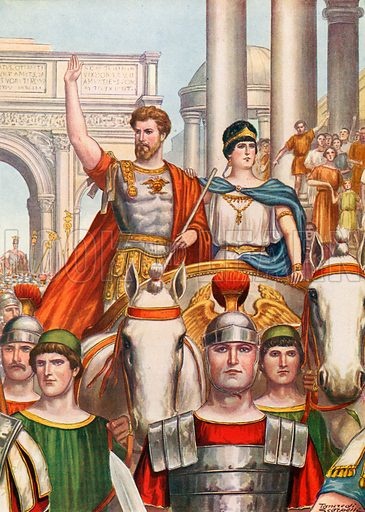
This was not the only option. The French Empire was indeed less racist, with small numbers of loyal non-whites admitted to the French elite. But Britain always had a majority who saw White Racism as vital to their identity. There were a few among the elite who did want to relax racial rules. But only a few, and ordinary Britons tended to have a racism that only gradually broke down when large numbers of non-white British subjects started arriving in Britain after World War Two.
Without the Soviet Union being there as a champion of multi-racism, White Racism might have continued to be the norm.
For the then-undivided Indian Subcontinent in 1939, Congress were the majority party in a very weak parliament. They objected when the British-appointed Governor General took India to war against their wishes. They demanded some promise of serious Home Rule. Gandhi and the others were jailed for the duration of the ‘war for democracy’.
Decolonisation for the various European empires and Civil Rights in the USA happened at a time when most of those who’d been excluded were looking to the Soviet model as an alternative. So the West’s elite gave up many things, from a very real fear of losing far more.
It had been the same in the 19th century. The revolutions of 1848 were mostly defeated, but fears of a repeat led to most of their demands being granted by the 1870s. And it was found that most of the rural population would reliably vote for conservative candidates, outweighing the much more radical cities.
Britain had no revolution, but the ruling class were always aware that it might happen. By the 1880s, the British Isles had given a vote and a secret ballot to a majority of adult men.[15] Though Ireland was different: even the much more limited reform of 1868 allowed a new Home Rule party to emerge. To become dominant outside of Northern Ireland by 1885.
And it became a Home Rule crisis, because the mainstream British view was that Roman Catholics were second-class members of the White Race. It was unacceptable for them to dominate a Home Rule government within the British Empire, even though Parnell and many other major leaders were Protestant. In the end it was resolved by separating Northern Ireland, which had a Protestant majority.
Dollar Crusaders
The great Western crusade that began after the Soviet collapse was supposed to give the world democracy. And for these crusaders, democracy was not genuine unless the country had a powerful national parliament where rival political parties contended for power.
If foreigners were under the impression that their home-grown autocratic government was efficient and doing what a majority wanted, as in China, this error must be corrected.
China at the start of the 21st century was likely to have been next for invasion, if the USA had conquered the ‘Axis of Evil’.[16] Possibly followed by Cuba and Libya, before tackling China. But the main thrust faltered when the Western invaders wantonly trashed Iraq’s state machine: they were wrapped in illusion and failed to realise that Baath Fascism was the most pro-Western force that could actually rule Iraq. The best unifying element for the three provinces of the Ottoman Empire that the British Empire had lumped together under a king from a South Arabian family that Lawrence of Arabia had recruited as clients of Britain.
Bush Senior in his war of 1990-91 had been content to let the Baathists stay in power, though he wanted them to replace Saddam Hussein as a sign that they would henceforth not dare to be independent of US wishes. He in fact allowed the regime with Saddam still in charge to use air power to supress a revolt that looked likely to bring Islamists to power. He had been Vice-President under Reagan in 1987, when US power allowed Saddam to survive the failure of his unprovoked and aggressive war against Islamist Iran.[17] In 1999 I commented that the continuing pressure on Iraq was an attempt to throw away the spider but keep the web functioning, and unlikely to work.[18]
Bush Senior had been content to do business with elites who were independent-minded, like Iraq under Saddam. To wait and see with Iran and North Korea. The next generation were less wise and much greedier, with Bush Junior notable among them. President, though probably as a front for men who were older but actually no wiser.
The US government ignored the request by the Taliban to have Osama Bin Laden’s guilt demonstrated under Islamic law. I’d have seen this as an each-way bet: they could have delivered Bin Laden and his followers, and had they rigged a court to find him not guilty of the Two Towers attack they would have hugely damaged their Islamic prestige. But the US elite thought they could take it all and set an example of successful ‘Democratic Capitalism’ to an Islamic world that preferred its own values. And then Bush coined the term ‘‘Axis of Evil’, and seems to have actually believed it, allowing the entire Baath machinery in Iraq to be destroyed. Which of course produced chaos rather than successful Democratic Capitalism. Rival versions of Islamism, Sunni and Shia and each in several rival shades. And Kurds who were closer to Western values, but the Turkish Republic did not want any Kurds anywhere making their own state. The occupation bogged down. They never were able to move on and conquer Iran and North Korea.
Elsewhere they had some destructive success, including encouraging an Arab Spring that had begun spontaneously in Tunisia. And has since spontaneously collapsed, with the Tunisian experience of ‘open government’ causing a majority to prefer a replacement autocrat.
If in a mundane sense the global Dollar Crusade led to weak government and communal strife, this did not weaken the fixed belief of Western politicians that they knew what was good for those silly foreigners.
Western Failures
The centre-right mostly remain very stoical about the suffering of people they don’t know and don’t value. Meantime the centre and centre-left agonise over their failures, but keep encouraging more of the same.
Part of the problem is a lack of knowledge of history. Or a false knowledge gained from the twisted works of New Right enthusiasts and weak liberal whiners.
In their mediaeval European origins, parliaments were at best a partial democracy, confined to a rich minority. That’s sticking to the current English meaning of parliament: it originally could mean any discussion group.[19] In France before the Revolution, parlements were judicial rather than legislative bodies, and composed of magistrates.[20] And the new USA chose to call it Congress. All round the world other names may be used, sometimes translated as parliament and sometimes the untranslated foreign word. (Dail, Storting, Bundestag, Rajya Sabha + Lok Sabha, National Diet, etc.)
In Britain, it strictly means the three-fold combination of House of Commons, House of Lords, and Monarchy. Similar divisions were found elsewhere, sometimes with separate chambers for bishops and secular lords. Sweden’s Riksdag also separated burgers and peasants.[21] France had a three-chamber Estates General, which in the Revolution transformed itself into a National Assembly.
These parliaments were a West European idea, based on other older forms of partial democracy or limited democracy. People knew about rights to vote for the better-off ordinary people among the Classical Greeks, Imperial Romans, Early Christians, and Germanic assemblies – ‘Things’ for Scandinavians. It was not however seen as normal or natural elsewhere. And before modern times, almost all societies believed in various forms of inherited power, distinct from but linked to their religious beliefs. Mostly a monarch who was a link between Man and God, even if they might not be personally very worthy. It’s a view that survives with the Papacy, and also the Emperor of Japan.
Europe’s various parliaments were not expected to rule, or even to meet regularly. But the monarch was expected to get their approval for important decisions, including new taxes. They were also needed to confirm even the most regular succession, and were supposed to find the lawful heir when this was disputed.
The English parliament gained importance because of the long run of disputes over the throne in the Wars of the Roses. And gained more when the nation’s religion was redefined – a monarch acting alone was not seen as enough.
All of this needed a partnership between House of Commons and House of Lords. And the ‘commons’ were originally elected by maybe one seventh of the adult male population. Knights of the Shires, and Burgess as the elite of towns and cities.
It did have one feature I like, but which was sadly lost in the various reforms. Most seats returned two members. In the 18th and 19th centuries, this was often one Whig and one Tory, later transformed into Liberal and Conservative. The views of a substantial minority in a region were less likely to be set aside.
In today’s world, most states with open democracy also have some sort of proportional representation. Usually a range of parties from left to right. Better democracy than the recent US election, where Trump has 90% of the power with just under 50% of the votes. With a more normal system, Bernie Sanders might have won a run-off election in 2016. And Trump would not have beaten Hillary Clinton without the weirdness of the Electoral College. In recent years it gives excessive weight to states with relatively small populations: farmers heavily dependent on Federal subsidies created by the New Deal, but bitterly against keeping New Deal promises for anyone else.
In Britain, Thatcher never had a majority of votes. Early on, much of the Tory Party resisted her. With proportional representation, she would never have been able to demolish the successful Mixed Economy system that had begun in the crisis of the 1940s. Which produced its own crisis in the 1970s, but was far from hopeless. The likely outcome would have been minor adjustments that brought the Trade Unions back to a more normal role, assuming that most of them had continued to neglect or oppose the possibilities of Workers Control and Incomes Policy.
Versions of Partial Democracy
People sometimes declare that anything less than an equal vote for 100% of adults of both sexes is not democracy. This dogmatic view does not bring clarity to the actual process by which democracy emerged.
Many states had a powerful Council that the monarch needed to consult. And which sometimes chose the next monarch, like the Anglo-Saxon Witan.[22] But these were individuals powerful in their own right, with most having inherited their position. Bishops were theoretically chosen by small groups of lower clergy, but commonly imposed by someone powerful. Commonly came from elite families. Appointment by the pope was unknown until the Counter-Reformation of the 16th century, though a bishop not recognised by the pope would have uncertain status. But even where elections of bishops were free and open, the vote did not include even a wider body of moderately privileged Christian men within the bishop’s diocese (territory).
Note that it was only men, in virtually all cases before the 20th century.[23] I don’t know of a case before modern times of a woman being elected to lead any organisation that was not women-only: places like nunneries and some trade bodies. But sometimes closeness in blood or personal wishes of a paternal monarch got a woman elevated to monarchy in preference to more distant male relatives. This caused an English civil war with Stephen and Matilda, but Henry 8th got parliament to confirm his two daughters as heirs after his son, ignoring the claims of men who had valid Plantagenet ancestry. And much later this broke up the union between the British Empire and Hannover. Britain gave preference to teenage Victoria. Her deceased father had been the elder brother of Ernest Augustus, who became King of Hannover because Hannover would not accept a female ruler.
Britain gave a vote in national elections to women over 30 in Britain from 1918, in part as a reward for the white-feather harassment of men to join the army during the war. Single women ratepayers had gained the right to vote in local elections in 1869, and there were other isolated examples. But it was mostly a 20th century development, often quite late. No French woman voted before 1945,[24] because radical republicans expected a majority to be hostile. Freedom-loving and tolerant Switzerland denied them a vote at the federal level until 1971.
All this was part of recognising that adult women were fully human: that they were as fit to exercise power as adult men. So how did democracy develop when it was mostly men only?
You can call it a sort of democracy when a powerful or even a ruling council is chosen by a wider body of less privileged men. Athens had it at times, as did some of the other Greek city states. But this was Restricted Citizenship Democracy. Rich and poor had a vote based on some inherited quality, rarely shared with new arrivals.
Much more common was Property Qualified Democracy. This excluded those lacking qualifying wealth or property. That was the British system till 1918, when all men got the vote along with some women. But it was still democracy, in the sense that it was a free choice among those qualified.
Ancient Rome had Restricted Citizenship Democracy. Its South Italian allies only took part in the key votes after fighting a war, misleadingly called the Social War in many sources. That was a half-arsed translation of bellum sociale, ‘war of the allies’.[25] Almost as bad as having Greeks in translation say ‘barbarians’, and then needing to explain that the term included civilised peoples not speaking Greek. Barbari should be translated as babblers; outsiders who mysteriously failed to understand plain Greek. Both are examples of the sad habit of many academics of keeping their own jargon at the expense of not being understood: and then they cannot comprehend why people mistrust them.
Ancient Rome also had Property Biased Democracy. Citizens voted, but various divisions of tribe and property-based class made their votes very unequal. And on top of that the Senate was only open to the extraordinarily rich, and then only if they had originally won elections to magisterial positions where the voters expected heavy bribes. I did a blog about this, calling it Rome’s Undemocratic Republic.[26] I’ve since thought more, and would now call it a very incomplete and unfair democracy. And stick to my view that it was entirely reasonable for the poorer citizens to let the Republic lose authority. Most citizens sensibly decided that the Emperors gave them a better say in their own lives than the Senate-dominated Republican system ever had.
Property Biased Democracy survived into modern times. Best known is the Prussian three-class franchise: the rich had far more electoral power, based on the taxes they paid.[27] That lasted from 1848 until 1918, and similar systems were found elsewhere.
Finally there is Apartheid Democracy. A strong bias or an absolute restriction to one race or religious group. I name it for its most familiar case; South Africa before Communist-trained and Communist-inspired Nelson Mandela reformed it. And earlier, before full Apartheid began, there had been a series of systems with a racial bias that made non-white voters less effective.[28] That sometimes let them vote but not be elected, which was also the status of better-off Roman Catholics in Ireland before Catholic Emancipation in 1829.
In the various colonies that were unified by Britain as South Africa, early voting rights did not exclude non-whites. But the property limits excluded most of them. Racism often has a democratic element – democracy just for ‘people like us’.
A few people have for years been saying that Israel was another Apartheid Democracy. Now it is becoming the general Western view. The dishonest tactic of attacking Jeremy Corbyn and other left-wingers by defining any criticism of Israel as anti-Semitic has run out of control, like a bolted horse. Netanyahu realised after the humiliating killing of settler Israelis on October 7th 2023 that he could authorise Israel’s citizen military to do absolutely anything, including mass killing of women and children. Any attempt to apply normal rules had become anti-Semitic by a rule that Western politicians had thoughtlessly signed up to.
Kamala Harris lost the recent election by feeling obliged to stick to this refusal to criticise. Trump got 3.08 million more votes than he did in 2020, but Harris got 6.27 million less than Biden. She lost by 2.28 million votes, in an election where the earlier bias based on the electoral college might not have been repeated. But where the total vote was only 63.9%, as against 66.6% in 2020. And a mere 60.1% in 2016, where Hilary Clinton lost in an election where many Trump voters would have voted for Bernie Sanders if the Democrat party machine had not sabotaged the votes of their ordinary members.
Had Biden been able to force a cease-fire on Israel before the election, the deft hand-over to Harris would probably have succeeded. But having hampered policies towards Israel with vehement nonsense, he was unable to do so. Non-voters and extra voters for the Greens were decisive.
Well before that, I had decided that the choice of direction by Israel’s Apartheid Democracy would be suicidal in the longer run.[29] As I had earlier warned the Hong Kong protestors.[30] Not the only time I have gone against the Received Wisdom of people who think that bitter rejection of the positive lessons of Stalin’s successful version of Leninism makes them incredibly wise. In 1989, I forecast that the Chinese Communists were not actually likely to lose power.[31] And in 1987, I had been confident that alarming British riots were not the start of a race war. That it was a ‘reformist riot’; a protest by people who wanted a less unfair spot in the existing system.[32] I admit to not having expected it to go as far as the Tories electing a black woman as leader: something that happened shortly before Kamala Harris began being described as having lost because she too was just that.
For the current crisis: if someone asks me if I recognise Israel’s right to exist, I’m happy to support it for the borders assigned to them by the UN in 1948. If that was an arbitrary act of power and biased by the Western dominance that still existed back then, so are most of the world’s borders beyond Europe. And while the extra territory in the pre-1967 version of Israel contained some Arabs they hadn’t driven out, they were able to give them votes and retain Jewish dominance. But since 1967, they have ruled vast numbers of additional Palestinians who have not been allowed to vote for Israeli governments. Who are only allowed to vote for governments with no real power: something that is correctly compared to the Bantustan system under South African apartheid.
It is a rare survival of Partial Democracy. Systems that were part of our evolution towards modern democracy, just as lizard-like creatures were part of the process leading to mammals, including some with fleshy sail-like organs on their backs. A process separate from the dinosaurs and birds, and which led eventually to us.[33] [34]
I have made the effort to clarify and describe this history, to make it clear that past democracies had a wider range than just the parliamentary system that England borrowed from foreigners. Restricted Citizenship Democracy; Property Qualified Democracy; Property Biased Democracy; Apartheid Democracy; Men-Only Democracy. I’ve had to invent names for these categories, because no one I’ve come across has seen any need to be clear about them.
All of these retained a feature that began when it was a game played just by the ruling elite. Open rivals could and did stand, and those with a vote could freely vote for them. Is this the only possibility?
I’ll speak later of Alternative Democracies. First, some thoughts about improving our own.
Vocational Democracy?
I’d meant to next have a section called ‘Subverted Democracy’. But anyone serious enough to read this lengthy article will already know of many examples. And might well say that the fact that a system is imperfect does not mean that a replacement would be better.
And I’d agree.
As well as the standard if it ain’t broke, don’t fix it, I would say if you can’t fix it, don’t try to break it. And British radicals after the French Revolution and the years of Napoleon’s autocracy mostly took the view that a British revolution was not the answer. That reforming Britain’s existing imperfect system of Property Based Democracy was better than hoping for a successful revolution creating some near-perfect system.
All of the demands of the radical but mostly non-revolutionary Chartists have been met. All apart from Annual Parliaments, a doubtful idea that seems not to have been tried anywhere.[35]
I will speak later of the merits of Alternative Democracy. But that does not mean I think it possible or desirable for Britain, or any other part of Europe west of Russia. It is part of our past, and part of the history of Continental Europe, where Enlightened Despots were the main creators of liberal and modern values. And where parliaments then continued and modified what existed, with voters freely accepting values that had once been forcefully imposed on them.
Parliaments became our norm. But we have discarded some aspects across the decades. We could maybe do better by discarding more. A system of local elites choosing a man they’d met face-to-face was sensibly territorial, but need we stick to that?
I’ve always felt an obligation to vote, but for a series of territorial seats that I found arbitrary. A constituency within the London borough of Walthamstow, then Islington, and then Hackney. Peterborough, and then North West Cambridgeshire after the strongly Labour district of Fletton was detached from Peterborough. There were suspicions that this was to save the city constituency for noted Tory Brian Mawhinney in the 1997 election, but in the event he stood for North West Cambridgeshire. Labour won the city in 1997 and 2001, lost it in 2005. My vote in a strongly Tory constituency was obviously not effective, but I kept asserting my right to cast it.
I have not spent even half of my life in any one region. Common enough now, but a great novelty for most people until the last century or so.
The other great weakness is politicians ‘parachuted in’. Outsiders chosen by a local party machine that looks to central power.
I’d suggest Britain could reform itself by changing the essential mechanisms. I’d not wish to dispense with nonsense like Black Rod at the opening of parliament. I’d see our monarchy as useful if it would move to the modest version offered by most of Europe’s surviving monarchies. I assume that silly Charles will stick to the forms he grew up with and yearned to be central in for most of his life; but maybe Prince William could be persuaded. Turn the controversial gold coach into something just for tourists to hire and be photographed in.
The House of Lords could be replaced with a House of Experts. Jobs for life, and a voice for people with real skills and knowledge. And a comfortable place for retired or de-selected MPs. Eligible to be ministers, but this House of Experts should have much less power to obstruct the elected MPs.
But it is voting for MPs that urgently needs to change.
I’d suggest making it half regional and half vocational. I would also prefer that regions and vocations would have three or four MPs, similar to the system in the Irish Republic. But that is a separate issue: not everyone approves of Proportional Representation. It can cause weak government.
Whether proportional or first-past-the post, I’d add a requirement that regional MPs must have spent at least half their lives in the region they wish to represent.
If commuting, it would count half for where they worked and half for where they lived. Home is where the cash is, in many cases.
For vocations, they would have to have spent a majority of their working life there. Move them to the House of Experts when they’d spent too long as professional politicians.
There is the matter of talented individuals who hadn’t spent half their lives in either one region or one vocation. For them, include 12 Whole-Britain MPs among the regional half of the new parliament. Allow for the way many of us are now highly mobile.
Vocational voting would correct the excessive power of what I call the Opinions Industry: lawyers, journalists, academics, and people working in think tanks and political machines. Such people would be limited to the actual number of vocational MPs their numbers merited.
In my own case, I’d probably not have entirely agreed with MPs elected for the data processing industry. But I’m sure I’d have felt closer.
One more idea – MPs currently have the same vote regardless of who voted for them. This is the justification for trimming or shifting constituencies, to ensure that the potential electorate is always similar. Before spreadsheets became a routine facility, a simple one-MP-one-vote system might have been unavoidable. But now, why not make it that each MP casts the number of votes that were cast for them? It would mean that people didn’t feel their individual votes were wasted or trivial: each vote would continue to count.
This would be a sensible and modest reform of a system that no one now much likes. The Workers Party of Great Britain could make it a big issue.
Alternative Democracy
I said earlier that Alternative Democracy was not possible or desirable for any part of Europe west of Russia. We must recognise that Western bungles from the 1990s have solidified what was always a loose geopolitical divide. We should revive the name Middle Europe (Mitteleuropa) for everything that is east of Berlin but west of most of what was once Tsarist territory. Finland and the Baltic Republics should count with Middle Europe, and maybe the anti-Russian bulk of Ukraine when they release the portions that now feel closer to Russia. Call the rest Far Eastern Europe, or even Western Eurasia.
The history of Western Europe and Middle Europe has given many of its inhabitants the fixed idea that voting for rival parties is an essential right. Of course many don’t bother to vote, but you can’t make a political movement out of the politically inert. Whatever else happens in Europe and in former colonies dominated by people originally from Europe, those countries will expect to have some reformed version of the system. Foolish to suggest otherwise, like the Trotskyists with their continuous notion of ‘Workers Councils’ (soviets) replacing other politics.
Workers Councils took power in 1917 in the Tsarist Empire, because the parliament or State Duma had never possessed significant power. They were lost when the overthrow of the Tsar suddenly put them in charge. They knew how to protest and make elegant speeches, but they had never been a serious part of Russia’s government. The Duma dated only from 1905, and had been elected by a rich minority. Its best idea when it became the supreme authority was to call a Constituent Assembly, which would have been highly likely to fail in the same way similar bodies had failed elsewhere. Lenin was broadly in line with the wishes of the majority, when he used the Bolshevik majority in the Soviets to disperse it.
In this Western-style vote, only 23.26% voted Bolshevik. But a further 53.31% voted for some other sort of socialism:[36] including 12.58% for separatist socialists in Ukraine. The main rival socialists, a Socialist Revolutionary Party that was descended from the individual terrorism of earlier nihilists, split into Left and Right. The Left was in a coalition with the Bolsheviks until its leaders split over the Brest-Litovsk peace. And by that time, many others had decided Bolshevism was the only workable answer.
The most West-European-minded party, the Constitutional Democrats or Kadets, got a mere 4.58%. They vanished as a significant force. The White Guards, the only significant challenge to Bolshevik power, were closest to the European fascism that was emerging elsewhere.
It seems unlikely that any combination of parties in the 1917 Constituent Assembly could have turned Russia into something similar to what then existed in Continental Western Europe. Those were end products: Enlightened Despots had been the main creators of liberal and modern values in those countries.
Britain never exactly had an Enlightened Despot, with Charles the First failing in his efforts to become one. With William of Orange frustrated by the inbreeding that denied him an English-speaking Protestant heir he could hand over to. History was almost certainly changed by the death at age 11 of Queen Anne’s only healthy son from a tragic sixteen pregnancies.[37] This and the equally tragic lives of Mary Tudor and her half-sister Elizabeth are part of the reason I absolutely reject the idea of some benevolent God shaping our lives.[38] Any superior power that exists would have to be very distant, and perhaps with end goals that would surprise the current crop of humans. The idea of a Supreme Being looking over the shoulders of each of us to check our behaviour and punish our sins seem to me a relic of something that helped make civilised humans, but which we have grown beyond.[39]
For monarchs as the earthy representatives of God, the prestige of the monarchy declined with the first two Hanoverian monarchs, who spoke no English. But what flourished was corruption rather than democracy. Not even a limited democracy of the richest one-fifth or one-seventh of the men: a couple of hundred super-rich families controlled a majority of the seats in a House of Commons. An assembly full of Rotten Boroughs: places with very few voters.[40] So there was some support when George III almost made himself a Benevolent Semi-Despot with a majority in Parliament.
Had George III and his ministers had the foresight to give the thirteen North American colonies a couple of MPs each, their later secession would have been unlikely. The original slogan was no taxation without representation, after all. With MPs from British North America, with the popular George Washington probably one of them, feelings of identity might have converged. The Whigs would probably have absorbed New England. The main slave-owning states would have felt more at home with the Tories. The possibility of a rebellious United States of America would have been remote.
What we have is the result of a series of accidents.
People in most cultures beyond Europe do not trust either their immediate neighbours or the wider population to choose wisely, when selecting leaders of their nation. Or even trust themselves to choose wisely between two or more people they do not know.
The attempt by Europe’s colonial empires to give copies of Western Europe’s existing politics to former colonies did not go well. They were expecting the end product of a long struggle to work smoothly when the social foundations and experience were not there. The surprise is not that many fail, but that some succeed. And success centred on an autocratic leader seems unsurprising to me. Had Indira Gandhi stuck to that role, and avoided being killed, we might not have the current autocrat who pushes a sectarian version of Hinduism.
I also no longer see it as odd that the attempt by Gorbachev to turn the Soviet Union into something Western was an utter failure. Boris Yeltsin neatly showed one vast weakness – an individual good at getting elected may be entirely useless at actually ruling. Most Russians now despise him and Gorbachev.
The Soviet Union might have survived and remained strong had they followed Deng Xiaoping’s advice and kept the Leninist system while they changed the economy.[41] They could also have withdrawn from the Warsaw Pact countries with firm guarantees of neutrality. Probably most of those countries would have returned to the parliamentary systems that they had operated very imperfectly before World War Two. But Russians just wanted the system run decently.
Putin’s extraordinary power comes from a series of open elections. I take this to mean that the culture has never ceased to be something different from Western Europe. Historically, having Mongol hoards for neighbours was stressful. Likewise Ottoman Turks based in Crimea doing massive slave raids on Russians and Polish-ruled Ukrainians. This naturally produced a desire for strong government. Created a tradition of respect for anyone who could make the nation strong. Nostalgia for Stalin’s rule remains widespread.
That’s Russia, which however sticks with the parliamentary system that Gorbachev incompetently created. That Yeltsin incompetently ran. Ran by briefly becoming more like an autocrat, including shelling the parliament that he had heroically defended during the coup against Gorbachev. And did all this with full Western approval.
Meantime, People’s China entirely merits its name. People do not vote directly for their leader. But they mostly approve of President Xi, and he delivers what most of them want.[42] I’ve explained elsewhere why the brief inclination to copy the West was wrong.[43] How by avoiding Soviet mistakes they have delivered most of what the Soviet Union left unfinished.[44]
And I’ve explained elsewhere how much we owe to what Moscow-Centred Leninism did achieve.[45] How different the world might be without their successes.[46][47] And how far Western leftists needed them.[48]
In BRICS, the other four of the original core all have a Western-derived political system. Regular multi-party democracy, though often denounced as dictatorships or at least authoritarian when it delivers what the people want rather than that for which the Western elite were hoping. These too are probably the best that can reasonably be expected.
[1] https://x.com/SenSanders/status/1896987251726524754
[2] https://mrgwydionmwilliams.quora.com/Ukraine-Kiev-From-2014-Wages-War-on-its-Russian-Speaking-Minority
[3] https://en.wikipedia.org/wiki/United_Nations_list_of_non-self-governing_territories
[4] https://x.com/SenSanders/status/1896987251726524754
[5] https://en.wikipedia.org/wiki/Timeline_of_abolition_of_slavery_and_serfdom#1850%E2%80%931899
[6] https://en.wikipedia.org/wiki/Timeline_of_women%27s_suffrage#19th_century
[7] https://labouraffairsmagazine.com/m-articles-by-topic/m99-topic-menus-from-long-revolution-website/998-from-labour-affairs/the-french-revolution-and-its-unstable-politics/040-politics/how-john-stewart-mill-twisted-the-idea-of-liberty/
[8] https://labouraffairsmagazine.com/m-articles-by-topic/52-usa/both-sides-were-racist-in-the-us-civil-war/
[9] https://mrgwydionmwilliams.quora.com/Why-Trump-isn-t-a-New-Hitler
[10] https://en.wikipedia.org/wiki/List_of_countries_by_number_of_military_and_paramilitary_personnel
[11] https://en.wikipedia.org/wiki/Yabloko#State_Duma_elections
[12] https://en.wikipedia.org/wiki/Septimius_Severus
[13] https://en.wikipedia.org/wiki/File:Carole_Raddato_(13543792233).jpg
[14] https://www.lookandlearn.com/history-images/M808290/Septimus-Severus-entering-Rome-with-a-beautiful-wife
[15] https://labouraffairsmagazine.com/m-articles-by-topic/40-britain/665-2/
[16] https://en.wikipedia.org/wiki/Axis_of_evil
[17] https://labouraffairsmagazine.com/very-old-issues-images/magazine-001-to-010/magazine-004-october-1987/why-the-west-saved-saddam-hussein-in-1987/
[18] https://gwydionwilliams.com/newsnotes-historic/newsnotes-to-2009/newsnotes-before-2001/newsnotes-1999-01/
[19] https://en.wikipedia.org/wiki/Parliament
[20] https://en.wikipedia.org/wiki/Parlement_of_Paris
[21] https://en.wikipedia.org/wiki/Riksdag_of_the_Estates
[22] https://en.wikipedia.org/wiki/Witan
[23] https://en.wikipedia.org/wiki/Timeline_of_women%27s_suffrage
[24] https://en.wikipedia.org/wiki/Women%27s_suffrage#France
[25] https://en.wikipedia.org/wiki/Social_War_(91%E2%80%9387_BC)
[26] https://mrgwydionmwilliams.quora.com/Rome-s-Undemocratic-Republic
[27] https://en.wikipedia.org/wiki/Prussian_three-class_franchise
[28] https://en.wikipedia.org/wiki/Elections_in_South_Africa
[29] https://mrgwydionmwilliams.quora.com/Suicidal-Zionism
[30] https://mrgwydionmwilliams.quora.com/Hong-Kong-Committing-Suicide
[31] https://labouraffairsmagazine.com/very-old-issues-images/magazine-001-to-010/magazine-012/what-tiananmen-1989-was-really-about/
[32] https://labouraffairsmagazine.com/m-articles-by-topic/m99-topic-menus-from-long-revolution-website/998-from-labour-affairs/the-french-revolution-and-its-unstable-politics/20-british-history/reformist-rioting-brixton-1987/
[33] https://en.wikipedia.org/wiki/Synapsida
[34] https://en.wikipedia.org/wiki/Edaphosauridae
[35] https://en.wikipedia.org/wiki/Chartism
[36] https://en.wikipedia.org/wiki/1917_Russian_Constituent_Assembly_election
[37] https://en.wikipedia.org/wiki/Prince_William,_Duke_of_Gloucester
[38] https://labouraffairsmagazine.com/past-issues/labour-affairs-before-2014/mary-tudor-and-elizabeth-almost-a-beautiful-story/
[39] https://labouraffairsmagazine.com/m-articles-by-topic/040-religion-as-a-mode-of-human-existence/religions-as-imperfect-human-understanding/
[40] https://en.wikipedia.org/wiki/Rotten_and_pocket_boroughs
[41] China Now Allows Less Capitalism, https://labouraffairs.com/2024/10/01/notes-on-the-news-32/
[42] https://labouraffairsmagazine.com/problems-magazine-past-issues/post-liberalism/chinese-politics-working-well/
[43] https://labouraffairsmagazine.com/m-articles-by-topic/m99-topic-menus-from-long-revolution-website/42-china/42-1-chinese-politics/china-rejecting-the-western-political-system/
[44] https://labouraffairsmagazine.com/f-free-pamphlets/china-as-a-new-civilisation/
[45] https://labouraffairsmagazine.com/m-articles-by-topic/politics-various-articles/how-marxism-redefined-our-society/
[46] https://labouraffairsmagazine.com/problems-magazine-past-issues/what-if-the-russian-revolution-hadnt-happened/
[47] https://labouraffairsmagazine.com/problems-magazine-past-issues/problems-magazine-older-issues/how-the-vietnam-war-extended-freedom-in-the-west/
[48] https://labouraffairsmagazine.com/m-articles-by-topic/m99-topic-menus-from-long-revolution-website/998-from-labour-affairs/the-french-revolution-and-its-unstable-politics/against-globalisation/the-left-redefined-the-normal/
 Gwydion Madawc Williams
.jpg)